
Local SEO is the work of making a real business easy to verify, understand, and contact in the markets it actually serves. It is not a directory-submission race or a way to manufacture hundreds of city pages.
This 30-day plan focuses on controllable fundamentals: accurate business information, useful service and location content, authentic reviews, crawlable pages, technical health, and a reliable lead-response path.
Google's own Business Profile guidance says businesses should represent themselves consistently in the real world, use an accurate address or service area, choose the fewest categories needed to describe the core business, and generally maintain one profile per business. Start there: Google Business Profile representation guidelines.
Before day one: record the baseline
Capture:
- Current Business Profile name, category, phone, website, hours, and service area
- Search Console impressions, clicks, queries, and indexed pages
- Calls, forms, and booking requests by source where available
- Top service and location pages
- Review count, recent review dates, and unanswered reviews
- Mobile performance for the homepage and top landing pages
- Duplicate profiles, old addresses, and broken directory listings you already know about
The baseline is not a ranking promise. It gives the team something concrete to compare after the work ships.
Week 1: make the business information trustworthy
Day 1: confirm ownership and eligibility
Confirm the business owner controls the Google Business Profile and the official website. Document who has owner and manager access. Remove access that is no longer appropriate.
For a service-area business, confirm the address is handled according to Google's current eligibility and display rules. Do not create profiles for virtual offices, mailboxes, or locations that do not qualify.
Day 2: fix the business name
Use the real-world business name shown on signage, stationery, the website, and customer-facing materials. Do not add services, cities, phone numbers, or promotional language to the profile name unless they are genuinely part of the recognized business name.
Day 3: review categories
Choose the most specific primary category that describes what the business is, then add only the additional categories that accurately describe the core operation.
Google advises using as few categories as possible and selecting categories that complete “this business is a,” not every service the business happens to offer.
Day 4: align contact information
Confirm the website and phone number connect to the specific business or location. Align the public address or service-area language, hours, holiday hours, and primary contact details across the website and key profiles.
Formatting variations are not a reason to panic. The goal is accurate, recognizable, current information—not a brittle “byte-identical” myth.
Day 5: complete services and description
Describe the real services customers can buy. Keep the Business Profile description useful and free of promotional clutter or links, consistent with Google's current guidelines.
On the website, create a clear service inventory: service name, who it is for, what it includes, relevant areas, and the next action.
Day 6: add current visual proof
Upload recent, accurate photos that help customers understand the business, team, work, location, or equipment. Use images you own or are permitted to publish.
On the website, compress and size those images correctly. Add useful alt text when an image communicates content; decorative images can use empty alt text.
Day 7: resolve obvious duplicates and errors
Search for old profiles, previous addresses, and duplicates. Use the platform's appropriate correction or support process. Do not mark a legitimate competitor as closed or make edits you cannot substantiate.
Week 2: give every page a clear search job
Day 8: map services to URLs
List the primary services and the current URL that owns each topic. A service page should be distinct enough to answer a real customer decision.
Avoid splitting one service into many near-identical keyword variations.
Day 9: map markets to URLs
Create a location page only when the business has meaningful information for that market: services offered, local proof, team or branch details, travel considerations, and a real contact path.
If every city page would contain the same copy with a city name swapped, do not publish the set.
Day 10: improve the top service page
Rewrite the page around the customer's decision:
- What the service solves
- What is included
- Who it fits
- Process and expectations
- Factors that affect timing or price
- Relevant proof
- Service area
- Clear next step
Use one descriptive H1 and a concise title and description. Do not force awkward city-and-keyword repetition into every paragraph.
Day 11: improve the top location page
Add market-specific proof and context. Link to the services actually delivered there. Confirm the page does not imply a storefront, staff, or address that does not exist.
Day 12: make internal links crawlable
Google's developer guidance recommends normal anchor elements and says pages should be reachable from another findable page: Google's Search developer guide.
Link from the main industry or service hub to important child pages. Use descriptive link text. Remove redirect hops and repair orphan pages.
Day 13: add visible questions and answers
Use questions the sales, front-desk, and service teams actually receive. Answer them in the visible page copy. Do not add FAQ structured data to hidden or unrelated content, and do not assume markup guarantees a search feature.
Day 14: publish ownership and trust information
Make company identity, contact paths, policies, credentials, and authorship easy to find where relevant. State licenses, memberships, guarantees, and service claims precisely and keep them current.
Week 3: reviews, citations, and response
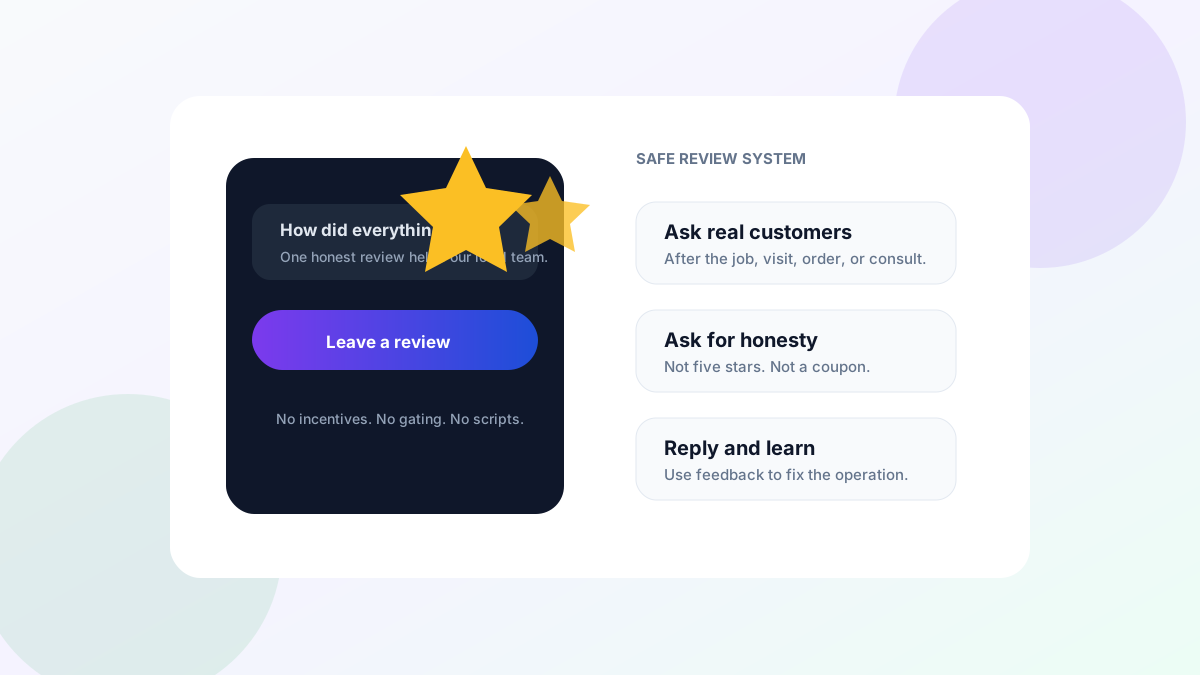
Day 15: create the review link
Google allows businesses to remind customers to leave reviews and provides a shareable link or QR code. It prohibits incentives in exchange for posting, changing, or removing reviews: Google's review guidance.
Generate the direct link from the Business Profile and store it in the approved follow-up template.
Day 16: define the review trigger
Choose a natural point after a real customer experience: completed job, visit, order, consultation, or milestone.
Send the same honest-review invitation to eligible customers. Do not send happy customers to Google while diverting unhappy customers elsewhere.
Day 17: write the request and follow-up
Keep the message short. Ask for honest feedback, include the direct link, and stop after a reasonable follow-up or opt-out.
The Google review request guide includes an implementation workflow.
Day 18: establish a response habit
Assign an owner to review and respond. Keep responses professional, useful, and privacy-conscious. Move account-specific or sensitive details to a private channel.
Day 19: audit the important directories
Start with profiles customers and search engines actually use: mapping platforms, major social profiles, relevant trade associations, licensing directories, and strong local organizations.
Correct inaccurate information. Do not buy a bulk package that creates low-quality profiles the business will never maintain.
Day 20: look for earned local mentions
Identify a legitimate relationship that could produce a useful mention or link: trade association, chamber, community organization, supplier, partner, event, scholarship, or genuinely newsworthy local work.
The link should exist because the relationship or resource is valuable, not because anchor text was purchased.
Day 21: test the lead path
Call the tracked number, submit the form, and use the booking path. Confirm:
- The request reaches the right owner
- The source is preserved
- The customer gets an accurate confirmation
- After-hours requests have a defined route
- Spam and wrong-area requests do not pollute qualified-lead reporting
Week 4: technical health and measurement
Day 22: verify indexing and canonicals
Use Search Console URL Inspection on the homepage and priority landing pages. Confirm the canonical points to the intended clean URL and the page is not blocked by robots.txt, a noindex directive, authentication, or an error response.
Day 23: review the sitemap
Include canonical, indexable URLs. Remove redirects, errors, duplicate variants, and pages that should not be indexed. Submit the sitemap in Search Console after material changes.
Google notes that a sitemap helps discovery but does not replace crawlable internal links.
Day 24: validate structured data
Use the most specific schema type that accurately matches visible content. Google says structured data must represent the page and does not guarantee a rich result: general structured-data guidelines.
Test with the Rich Results Test and URL Inspection. Remove fake ratings, unsupported prices, nonexistent locations, and duplicate entities.
Day 25: improve mobile performance
Run PageSpeed Insights and inspect the actual page on a phone.
Prioritize:
- Oversized hero images
- Offscreen images loading eagerly
- Autoplay video
- Excess font families and weights
- Layout shifts from missing dimensions
- Large scripts or database payloads
- Slow third-party embeds
Performance is a user-experience and crawl-quality issue, not a one-number contest.
Day 26: confirm each page has visible text
Important content should not exist only inside an image, video, or client-side state that never appears in the initial HTML. Google specifically recommends expressing visual content in text and using crawlable links.
Day 27: build the reporting view
Track:
- Search impressions, clicks, queries, and landing pages
- Business Profile interactions
- Calls, forms, and bookings
- Qualified versus spam or wrong-fit leads
- Response time
- Booked work or completed outcomes
- Indexing and technical errors
- Page performance
- Review workflow activity
Day 28: assign a monthly owner
Create recurring tasks for profile accuracy, review response, content updates, technical checks, and lead-quality review. Local SEO declines when no one owns maintenance.
Day 29: choose the next content cluster
Use real questions and query data. Choose a cluster tied to a service, audience, or operational decision the business can answer with experience.
Day 30: document the next quarter
Choose a small number of measurable objectives, such as improving qualified organic leads for a priority service, repairing coverage in a real market, or increasing the percentage of priority URLs that are indexed cleanly.
Do not promise a ranking position or invent a review quota. Set actions the team controls and outcomes it can measure.
What to avoid
- Keyword-stuffed business names
- Fake or ineligible locations
- Duplicate profiles
- Incentivized reviews or review gating
- Thin city doorway pages
- Unsupported awards, ratings, or performance claims
- Hidden or misleading structured data
- Internal links that redirect
- Publishing content with no connection to the business
- Measuring sessions without lead quality
Where Cacele fits
WebElevated can run the website, local SEO, content, paid media, and lead-response layer as a coordinated engagement. First Page provides an owned website and conversion-page foundation. Calendefy can connect qualified demand to guarded booking paths.
Home-service operators can continue with the home-services local SEO playbook, which applies the same principles to service areas, dispatch, reviews, and job response.
The 30-day plan is a build sequence, not a promise that search systems will react on a fixed schedule. Ship the foundation, measure what searchers and leads actually do, and keep the business information current.